Task-Based Model Selection in Enterprise Agentic AI

On July 9, 2026, OpenAI moved its GPT-5.6 family to general availability across three tiers, priced from $1 to $30 per million tokens. The release proves a hard truth for enterprise buyers: no single model wins every task, so task-based model selection is now a strategic requirement, not an optimization. Leaders who standardize on one provider trade measurable performance and cost efficiency for the false comfort of simplicity.
One Model Is Not Enough: The Evidence Is Now on the Benchmark Sheet
For two years, enterprise AI Transformation ran on a convenient assumption: pick the strongest frontier model and route everything through it. The GPT-5.6 launch ends that assumption with data.
OpenAI shipped three distinct tiers on the same day. Sol targets long-horizon agentic tasks and deep reasoning, with a multi-agent "ultra mode." Terra matches GPT-5.5 performance at half the price. Luna runs fastest and cheapest for high-volume work.
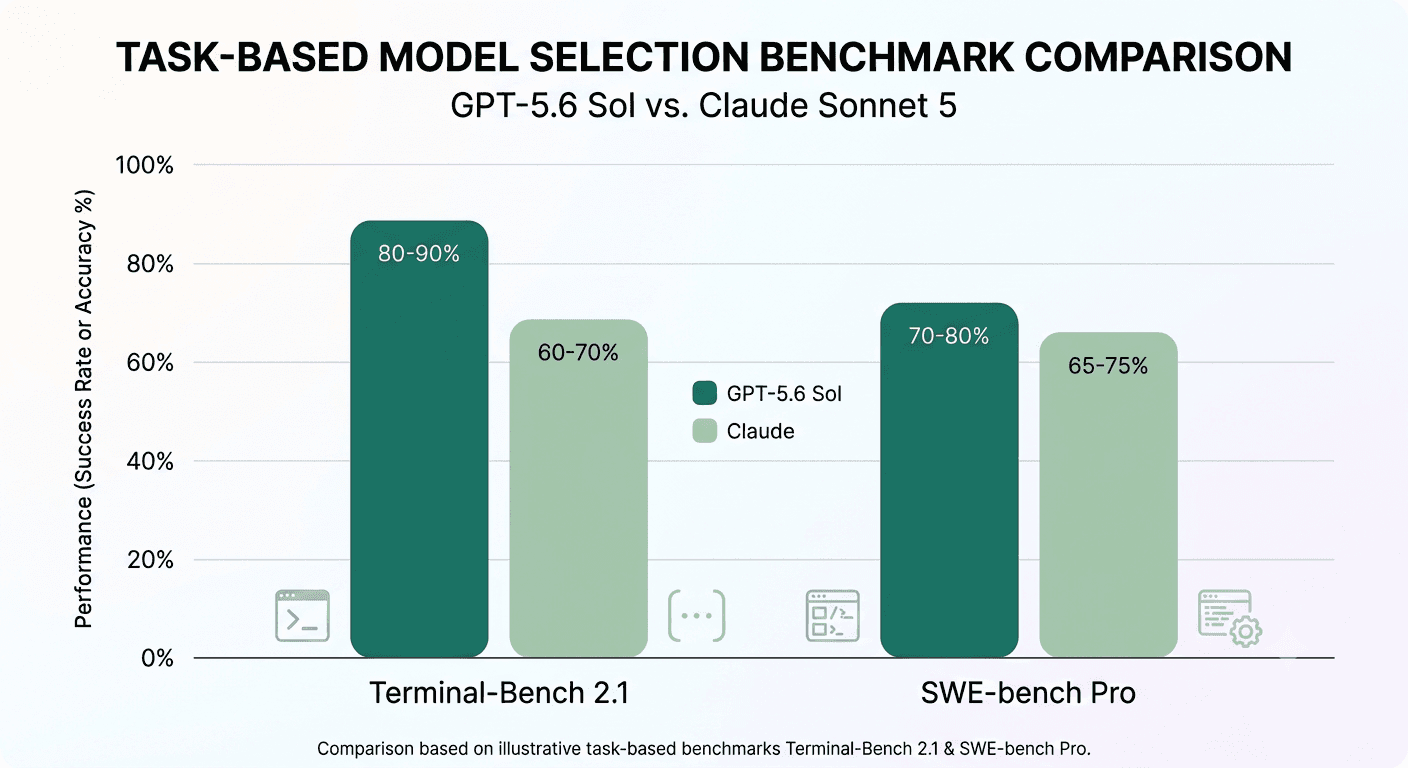
The benchmarks tell the real story. Sol Ultra leads Terminal-Bench 2.1 at 91.9 percent, ahead of Claude Mythos 5 at 88.0 percent. Yet on SWE-bench Pro, which measures repository-level coding, Claude Sonnet 5 scores 63.2 percent and beats GPT-5.5 at 58.6 percent.
Read that split carefully. The leader changes with the task. One model dominates terminal-driven agentic work; a competitor dominates deep repository engineering. A single-provider stack forces you to accept the loser on half your workloads.
Pricing Turns Model Selection Into a Line-Item Decision
Model choice is no longer only about accuracy. It is a direct cost lever, and the numbers are large enough to reach the CFO.
The GPT-5.6 tiers price sharply against each other, per million tokens:
Sol: $5 input / $30 output — frontier reasoning and long-horizon agents.
Terra: $2.5 input / $15 output — GPT-5.5-class performance at half the cost.
Luna: $1 input / $6 output — fastest and most affordable for volume tasks.
The efficiency gap widens further inside a single tier. Sol reaches comparable ExploitBench performance while generating roughly one-third fewer output tokens. For token-billed agentic workloads, that is a compounding cost advantage on every run.
Consider the math at scale. An enterprise routing millions of agent actions per month pays a very different bill when a routine classification runs on Luna instead of Sol. Routing every task to the top tier is not diligence; it is waste.
Task-based model selection converts this pricing spread into savings. Match each step to the cheapest model that clears the quality bar, and cost drops without touching output quality.
Single-Provider Lock-In Is Now a Strategic Liability
The strongest argument against standardizing on one provider is no longer philosophical. It is operational, financial, and regulatory at the same time.
Three forces make lock-in risky in 2026:
Performance drift. Leadership rotates with each release cycle. The best coding model this quarter may trail on agentic tasks next quarter, as the GPT-5.6 and Claude Sonnet 5 split already shows.
Cost exposure. A single price sheet governs your entire AI budget. You lose the negotiating leverage and the routing flexibility that a multi-model stack provides.
Regulatory timing. GPT-5.6 shipped only after a mandatory 30-day U.S. government review under the June 2026 AI cybersecurity executive order. Your provider's home-market regulatory calendar can now delay your roadmap.
That third point deserves attention from European and MENA leaders. When one U.S. provider controls your stack, its compliance timeline becomes your compliance timeline. A diversified architecture absorbs that shock; a locked architecture inherits it.
Gartner projects that agentic AI will disrupt $234 billion in enterprise SaaS spending between 2026 and 2030. The organizations that capture that shift will run modular, model-agnostic architectures, not single-vendor bets.
SKYMOD Connection: How SkyStudio Turns Multi-Model Strategy Into an Operating Model
Knowing that task-based model selection matters is easy. Operationalizing it across hundreds of workflows is the hard part, and that is the specific problem SkyStudio Workflow solves.
The Workflow module orchestrates multiple models inside a single agentic pipeline. Each step routes to the model that fits the task, not to a house default. A workflow can send repository-level coding to a Claude-class model, long-horizon planning to Sol, and high-volume extraction to Luna, within one governed process.
This design delivers three concrete outcomes for AI Transformation Leaders:
Performance per task. Every step runs on the model that leads its benchmark, so quality stays high across mixed workloads.
Cost control by default. Routing rules push routine steps to cheaper tiers, capturing the pricing spread automatically instead of hoping teams optimize by hand.
Provider independence. New models plug into existing workflows. When leadership shifts next quarter, you swap a node, not your platform.
The point is not that SkyStudio replaces any single model. It orchestrates all of them, so your strategy survives every release cycle instead of resetting with each one.
What AI Transformation Leaders Should Do Before the Next Launch
The GPT-5.6 release is not an isolated event. Anthropic shipped Claude Sonnet 5 in the same week, and Google expanded its Gemini tiers days earlier. The multi-model market is now the permanent condition, not a temporary phase.
Three moves protect your organization:
Audit your routing. Map which tasks run on which model today, and flag every workload stuck on a single provider by default.
Set quality bars per task type. Define the minimum acceptable model for coding, reasoning, and volume work, then route to the cheapest option that clears each bar.
Build for substitution. Choose an orchestration layer that treats models as interchangeable components, so the next launch is an upgrade, not a migration.
Closing Thoughts
Task-based model selection is the difference between an AI stack that improves with every release and one that ages with each one.
Next step: Map one high-volume workflow to its ideal per-task model mix this quarter. Request a SkyStudio Workflow demo to see task-based model selection routing GPT-5.6, Claude, and Gemini inside a single governed pipeline.